“NEVER” Put LEDs In A Halogen Projector? Almost Never. Here’s Why HID Wins
Share
Good hook. Not totally true.
There are edge‑case scenarios—like brutal Arctic cold, or an installation environment thats constantly heat-soaked—where a LED Headlight Conversion Kit can be the only possible way to get more lighting out of a car, truck, toy or machinery, even when it has a headlight unsuitable for an LED upgrade, like a halogen projector lens. But for the vehicles and bulb types most Canadian drivers are dealing with, a properly matched HID setup is almost always the better choice for real visibility, beam control, reliability, and long‑term satisfaction. Reflector style headlights are different and usually work great with LED. Do I have projectors or reflectors?
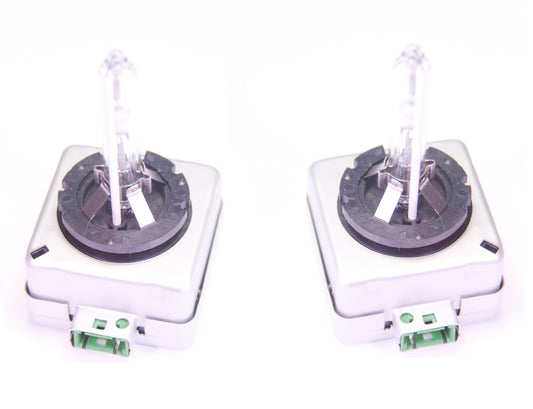
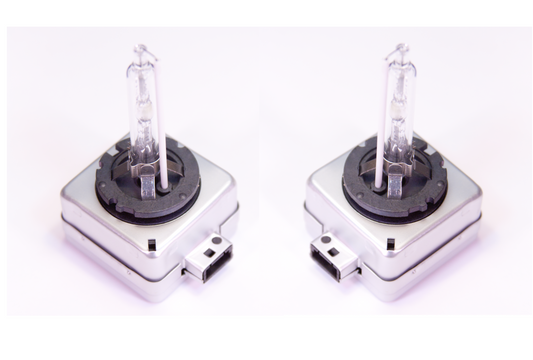
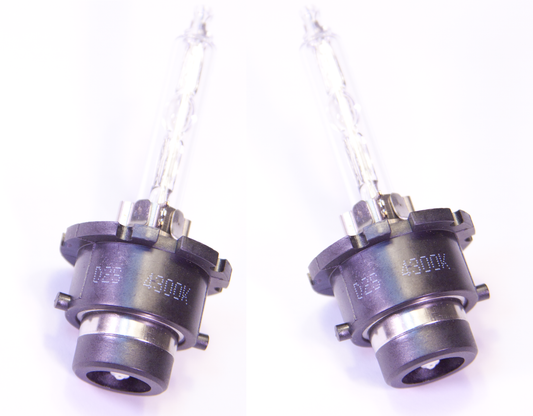
This is especially true for factory HID systems using D‑series bulbs (D1S, D2S, D3S, D4S, D5S), which are almost all in projectors, and for halogen projector systems using H11, 9005, 9006, 9012, and H7 bulbs. If your vehicle falls into any of those buckets, it is worth understanding why HID is usually the right answer and why most LED “plug‑and‑play” kits are a step in the wrong direction.
Why Projectors Love HID (And Hate Most LED Retrofits)
Projector headlights are built around one core assumption: the light source is small, precisely located, and radiates in a predictable and omnidirectional way. With a halogen projector (H11, 9005, 9006, 9012, H7), the filament is a tiny coil of wire that glows in almost all directions around its axis, the reflector bowl, cutoff shield, and lens are all designed around the exact size and position of that filament, and when everything is where it should be, you get a sharp cutoff, controlled width, and an OEM‑style beam pattern.
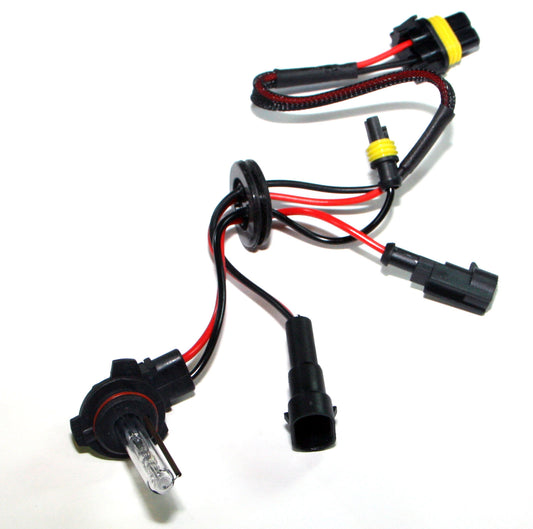
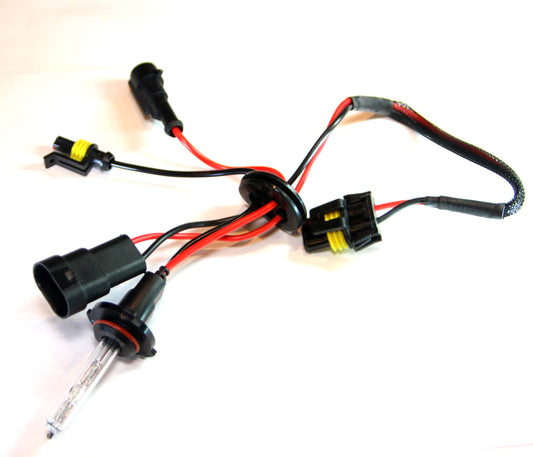
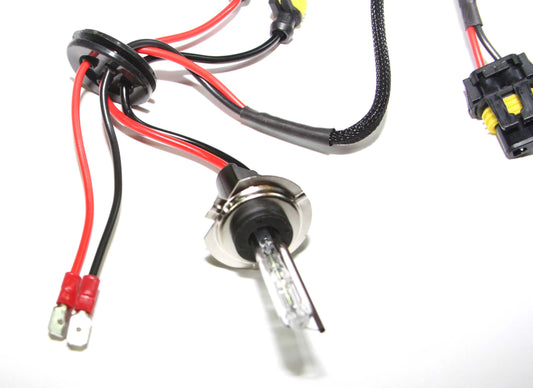
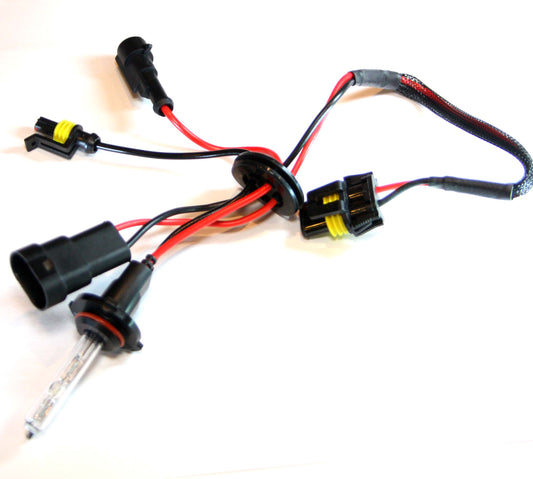
A good HID capsule plays by almost the same optical rules. The HID arc is a small, bright line of light, very similar in size and position to a halogen filament. Quality HID bulbs are built with tight tolerances so the arc lands exactly where the projector expects the filament to be. The projector still “sees” a compact, filament‑like light source, so the beam pattern stays sharp, wide, and controlled. That is why factory HID systems (D1S, D2S, D3S, D4S, D5S) almost always live in projector housings: the optics and the bulb technology are designed to work together.
LED retrofit bulbs break these rules. The chips sit on one or two flat boards, not at a single, thin focal line like a filament or HID arc. The emitting area is often larger and in the wrong place relative to the original focal point. Instead of one clean omnidirectional light source, the projector sees multiple bright patches and dead zones. On the road, that usually means fuzzier, scalloped cutoffs, hot spots in the wrong places, dark patches in the beam, and extra glare for oncoming traffic. The lumen number on the LED box might be huge, but what matters is where that light ends up. In a halogen projector, HID simply uses the optics as they were designed to be used. LED usually fights them.
Omnidirectionality: The Hidden Advantage Of HID
The big optical difference between halogen/HID and LED is how they emit light. Halogen filaments (H11, 9005, 9006, 9012, H7) form a small, thin line of light, radiate in nearly all directions around that line, and give the projector a full “shell” of light to work with. HID capsules (D1S, D2S, D3S, D4S, D5S and rebased HID conversions) are a small, bright arc inside a capsule, still behaving very similarly to a filament in terms of apparent size and shape and providing a concentrated line source at the focal point the projector expects.
LED retrofit bulbs, by contrast, use multiple flat chips on circuit boards, emit strongly in certain directions and weakly or not at all in others, and create bright islands of light and empty gaps instead of a clean, continuous line. Projectors are designed to work with a compact, omnidirectional source. When you feed them a segmented, directional source, they do exactly what the optics tell them to do: they magnify the inconsistency. That is why a well‑designed HID kit in an H11 or 9005 projector can give you a sharper cutoff, more even light from one side of the beam to the other, and stronger distance lighting while still controlling foreground and glare—and why the typical LED kit in the same housing often looks “bright” but drives worse.
Real‑World Beam Pattern: H11, 9005, 9006, 9012, H7
Let’s talk about the bulb types people actually shop for. H11 is a very common low‑beam projector bulb. When you move from halogen to a properly engineered H11 HID kit, the cutoff generally stays sharp, the beam stays wide with fewer gaps and streaks, and you see more of the road downrange instead of just a bright patch 10–20 feet in front of the car. Swap that same projector to a random H11 LED kit and you often get stray light above the cutoff, a “fried egg” hot spot in the center with weaker light to the sides, and impressive wall photos that turn into disappointing performance on a dark highway.
For 9005 bulbs used as high beams or in projector retrofits, a 9005 HID kit can push more lux exactly where the reflector or projector is designed to throw it, give stronger punch down the road for rural and highway driving, and keep the beam shape consistent with what the optics were designed for. With 9005 LED bulbs, the eye‑catching foreground can mask the fact that distance lighting is not actually improved and can sometimes be worse than stock. The same pattern holds for 9006, 9012, and H7: good HID capsules in these bases can produce smoother, more uniform beams and more usable reach, while LED retrofits in the same housings tend to over‑light the foreground, under‑light the distance, and send more uncontrolled light into other drivers’ eyes.
Factory D‑Series HID: Don’t “Upgrade” The Wrong Way
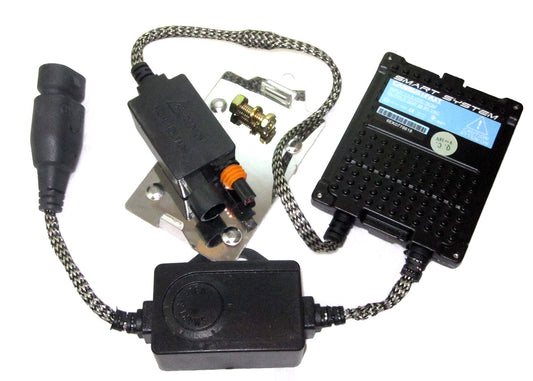
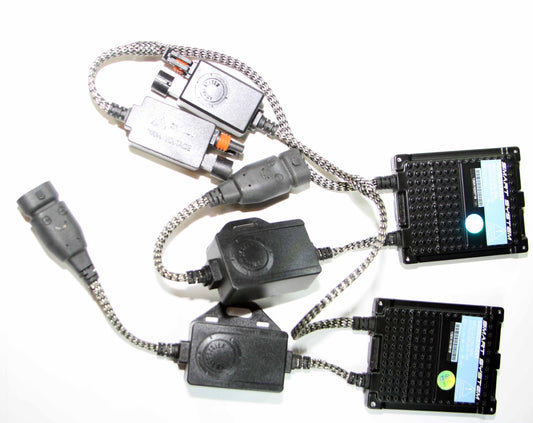
If your vehicle came with factory HID, you are almost certainly running one of D1S, D2S, D3S, D4S, or D5S. These systems are almost always projector‑based, and those projectors were specifically engineered around an HID arc capsule. The correct upgrade path is to replace old, color‑shifted, or dim D‑series bulbs with fresh, high‑quality HID capsules, replace failing ballasts with proper OEM‑style ballasts when needed, and keep the HID plus projector pairing that your headlight was built for. Trying to “modernize” a factory D‑series projector with a drop‑in LED kit usually makes the beam worse, not better: you lose the precise arc position and omnidirectional emission the optics expect and trade an OEM‑style pattern for something that might look whiter but performs worse.
Thermal Behaviour, Color, And Long‑Term Use
There are a few more practical reasons HID tends to win in projectors. In enclosed projector housings, LEDs have to fight their own heat, and as they warm up many LED bulbs lose output, while HID warms up, stabilizes, and then maintains a consistent level of light over a long drive. HID also offers usable color choices that balance style and performance; very high‑Kelvin LED kits can look icy white or blue but actually reduce contrast in rain, snow, and fog compared to more moderate HID color options. A good HID setup in a projector can be aimed and controlled, whereas a poor LED retrofit that ruins the beam pattern will get you more flashes from oncoming traffic, more attention from inspectors, and more eye strain for everyone else on the road. The goal is not “maximum advertised lumens”; the goal is maximum usable light where you need it, with minimum stray light where you do not.
So… Should You Ever Use LED In A Projector?
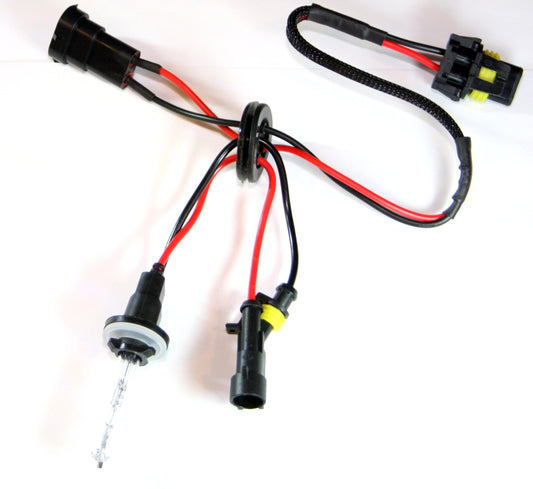
“Never” is too strong, but “almost never” is accurate for most halogen projector housings. LED has its place in headlight systems specifically engineered around LED from the factory, in reflector-style headlights that do not usually require omnidirectional light sources, and in niche environments where low‑temperature reliability and solid‑state simplicity matter more than raw beam perfection. But if you are dealing with projector low beams on H11, 9005, 9006, 9012, H7, or factory HID projectors on D1S, D2S, D3S, D4S, or D5S, a quality HID bulb or HID conversion kit is almost always the more correct choice, both optically and practically.
You get a light source that behaves like the original filament or OEM HID arc, a projector that can do its job properly, and a beam pattern that actually helps you see more, farther, with less glare.