Why HID Beats LED in Dual‑Filament Headlights (H13, H4, 9007, 9004)
Share
Why HID Beats LED in Dual‑Stage Bulbs (9008/H13, 9003/H4, 9007, 9004)
Dual‑filament bulbs like 9008 (H13), 9003 (H4), 9007, and 9004 create a specific challenge when upgrading from halogen to LED. In many LED “dual‑beam” conversions, the low beam only ever gets about half of the LED’s real output, with full power reserved for the high‑beam mode, which clashes with how these housings and North American (especially Canadian) daytime running light (DRL) logic actually work. Because most dual‑beam LED bulbs deliberately under‑drive the low‑beam stage, a properly set up low‑beam HID with a halogen‑style high beam will usually deliver much more real low‑beam brightness than an LED dual‑beam bulb ever does in its low‑beam mode. For most dual‑stage applications, a low‑beam HID conversion (or bi‑xenon where appropriate) offers a more functional upgrade than LED, especially when combined with a halogen‑style high beam or a dedicated bi‑xenon system such as the kits in the bi‑xenon HID upgrades collection.
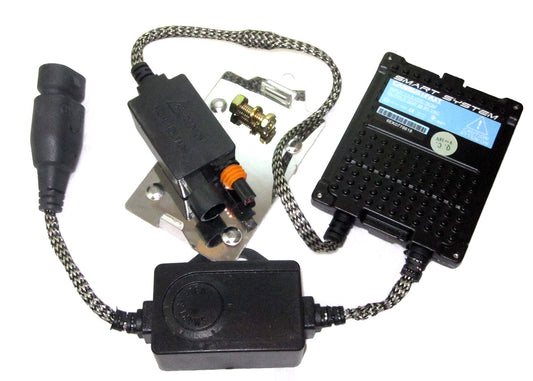
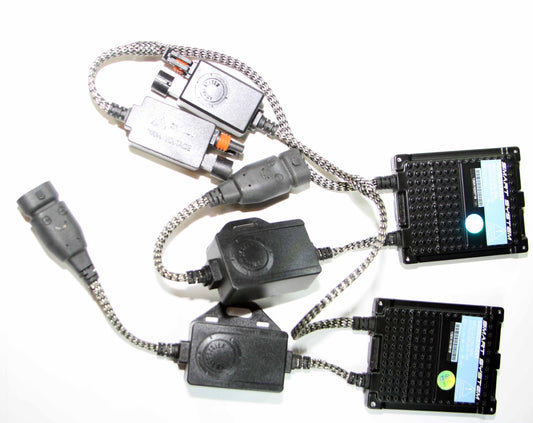
Bi‑xenon HID can provide HID low and HID high from one capsule, but it is usually not compatible with high‑beam DRL systems, especially on Canadian‑spec vehicles where the high‑beam filament is run at reduced power as a daytime running light. On those platforms, low‑beam HID with a halogen‑style high beam is normally the DRL‑safe default.
How Dual‑Stage Bulbs Work (9008, 9003, 9007, 9004)
Dual‑stage bulbs combine low beam and high beam in a single physical bulb, using two filaments and either a shield or different filament position to shape the beam. The 9003 (H4) type is common in older Japanese and European vehicles; it has one filament for low and one for high, with a mechanical shield and reflector geometry controlling the cutoff. The 9008 (H13) type is widely used in trucks and SUVs and has separate low and high filaments in one bulb. The 9007 and 9004 families are similar dual‑filament bulbs used in North American vehicles, but they differ in filament orientation, base keying, and wiring.
In halogen form, each filament is designed to run at its intended power whenever it is commanded on, so you get full low‑beam output in low mode and full high‑beam output in high mode.
LED Dual‑Beam Conversions: The Hidden Half‑Power Problem
Most popular LED replacements for 9008/H13, 9003/H4, 9007, and 9004 are built as a single LED body with two “stages” or two sets of chips: one for low beam and one for high beam. To keep heat and current in check, many designs split power between these modes. In low‑beam mode, only the low‑beam LED chips are lit, often at roughly half of the LED’s advertised maximum power. In high‑beam mode, the low‑beam chips may turn off and the high‑beam chips run at or near full power, so the big lumen number on the box only appears in that high‑beam setting.
Because you spend most of your driving time on low beam, this design means effective low‑beam output is capped below what the hardware could deliver. The beam pattern can be compromised because the LED emitter layout does not match the original filament positions. On vehicles that use the high‑beam circuit as a DRL at reduced power, which is common in Canada, the LED electronics can flicker, fail to turn on, or throw bulb‑out errors. This is why, in actual low‑beam driving, dual‑beam LED bulbs often look weaker than their advertised lumen numbers suggest, while HID systems run low beam at full power whenever it is on.
Why HID Works Better for the Low‑Beam Stage
An HID kit is designed to run at a constant rated power once warmed up; it does not reserve output for a separate high‑beam mode and simply delivers full rated output whenever it is on. In a dual‑filament conversion where you use a low‑beam HID and keep a halogen‑style high beam, the low‑beam circuit powers the HID kit at its rated wattage whenever the low beam is commanded, so the low beam is always at full power. A properly sized HID capsule with correct base and shield geometry sits where the original low‑beam filament was, so the reflector or projector can form the intended cutoff. Because low beam is used far more than high beam, putting the upgraded technology on low beam yields the biggest real‑world gain.
In practical terms, this means that in low‑beam driving—where you spend almost all of your time—a 35 W HID kit, running at full power, typically puts more usable light on the road than a dual‑beam LED bulb that is deliberately throttled in low‑beam mode to keep headroom for high beam. There is also an even brighter 55 W HID system that can be over 50% brighter again, for platforms and users where that level of output is appropriate. So even if the LED box advertises a large lumen number, you rarely see that output on the road in low‑beam mode, while HID runs at full power whenever low beam is on.
HID Low Beam + Halogen High Beam: Practical, DRL‑Friendly Default
A common, DRL‑safe solution for dual‑stage bulbs is to run a low‑beam HID kit on the low‑beam filament circuit and retain a standard halogen‑style filament for high beam, often refreshed with a new bulb of the same type. In practice this can mean pairing a low‑beam HID kit with dedicated high‑beam bulbs such as H4 high‑beam bulbs for H4 systems, 9007 high‑beam bulbs for 9007 systems, or H13 high‑beam bulbs for H13 platforms when you want to keep the high beam electrically simple and DRL‑friendly.
This configuration is the DRL‑safe default because the high‑beam circuit still “sees” a halogen‑style load and behaves as designed in DRL mode, which is critical on vehicles that run high‑beam DRL at reduced voltage. Installation is usually straightforward and issue‑free, since high beam behaves like stock and functions such as flashing to pass, DRL behavior, and dash indicators remain predictable, with minimal wiring changes. Most importantly, because the HID low beam runs at full power all the time, it usually produces a noticeably brighter, more consistent low beam than typical LED dual‑beam kits in their low‑beam setting. For 9007 and 9004 housings, this separation between HID low and halogen‑style high is especially useful because their dual‑filament design is sensitive to filament position and reflector geometry.
If you are unsure which path is DRL‑safe for your specific vehicle, the easiest way to get a precise answer is to contact us with your year, make, model, and bulb type, or call at +1 (647) 547‑1962.
9007 vs 9004: Why the Difference Matters
9007 and 9004 are often lumped together because they are both dual‑filament bulbs, but they are not identical and should not be treated as interchangeable in HID or LED conversions. The 9004 (HB1) type uses transverse filaments and typically lower rated output, while the 9007 (HB5) uses axial filaments and has higher low‑beam wattage and lumen ratings. Their focal positions and shield arrangements differ, which means the reflector forms the cutoff and hot spots differently for each design. The base keying and pin configuration also differ, so plug‑and‑play kits built for one may not map low, high, and ground correctly for the other without rewiring.
Each therefore needs its own correctly designed HID low‑beam or bi‑xenon kit that respects the original filament geometry and wiring. For customers specifically looking at bi‑xenon options in this family, the 9007/9004 bi‑xenon replacement bulbs are built for this footprint.
DRL Logic in Canadian‑Spec Vehicles: Why LED and Bi‑Xenon Often Fail
Canadian‑spec vehicles frequently use the high‑beam filament as a DRL by driving it at reduced voltage or with pulse‑width modulation (PWM). In this strategy, the high‑beam filament runs at roughly half power during the day for DRL, then at full power at night when high beams are selected. LED drivers, however, are not simple resistive loads like halogen filaments. When they are fed DRL‑style low voltage or PWM, many LED bulbs will flicker, fail to turn on, trigger bulb‑out errors, or behave inconsistently between DRL and full‑beam modes.
Bi‑xenon systems tied into the high‑beam circuit also run into the same problem. The reduced‑voltage or pulsed DRL signal can cause the solenoid and ballast to see unstable inputs, leading to chattering shields, mis‑triggered ballasts, or failure to ignite. This DRL strategy was engineered for halogen filaments, not modern LED or moving‑shield HID systems, and it is the root of much of the frustration Canadian drivers have with dual‑beam LED and bi‑xenon kits “not working” properly on high‑beam‑DRL vehicles.
By contrast, HID‑low / halogen‑high kits sidestep most of this. The high‑beam circuit still sees a halogen‑style filament and behaves as designed in DRL mode, and the HID low beam is powered by its ballast on the low‑beam circuit, which usually is not DRL‑modulated in the same way. If you are not sure whether your vehicle uses high‑beam DRL or which kit is DRL‑safe, the quickest answer is to reach out or call +1 (647) 547‑1962 before ordering.
Bi‑Xenon HID: HID Low and HID High From One Capsule
There is a dual‑HID system, often called bi‑xenon, that provides both low and high beam from the same HID capsule. Instead of a separate halogen high beam, bi‑xenon uses a magnetic solenoid at the base of the bulb to move a shield or the capsule itself, changing the beam pattern. In low‑beam mode, the shield creates the cutoff and low‑beam pattern. In high‑beam mode, the solenoid pulls the shield or capsule to expose more of the arc, giving a taller, longer beam.
The ballast always drives the arc at full power and the solenoid only changes geometry, so you get HID performance on both low and high beam from one capsule and a fast mechanical beam change. However, before choosing bi‑xenon, you must check whether your vehicle uses high‑beam DRL. If it does, bi‑xenon is usually the wrong choice, because the DRL signal can cause flicker, no‑high‑beam, or DRL faults. For readers whose DRL logic allows it, the bi‑xenon HID upgrades collection groups all dual‑stage bi‑xenon options in one place, including H13 bi‑xenon bulbs, H4/9003 bi‑xenon bulbs, and 9007/9004 bi‑xenon bulbs.
A very common mistake is installing bi‑xenon on a high‑beam‑DRL vehicle, then chasing flicker and no‑high‑beam issues afterward. If your DRL indicator or owner’s manual says “DRL = high beam,” treat bi‑xenon as off‑limits and use a low‑beam HID plus halogen‑style high beam instead.
Important Exception: Ford H13 Halogen Platforms
A notable exception is many Ford vehicles that use H13 (9008) halogen bulbs from the factory. Their wiring and DRL strategy often allow bi‑xenon and LED plug‑and‑play kits to work correctly. On a large number of Ford passenger and commercial vehicles with H13 halogen, the DRL strategy and high/low switching logic do not abuse the high‑beam circuit with the reduced‑power DRL drive that causes trouble elsewhere. Bi‑xenon H13 kits such as the H13 bi‑xenon replacement bulbs can often be installed plug‑and‑play, providing HID low and HID high from a single capsule, and LED H13 dual‑beam kits also tend to behave more predictably on these platforms than on vehicles that drive high‑beam DRLs aggressively.
For Ford H13 owners, bi‑xenon or LED can be strong options. For most 9003/H4, 9007, and 9004 Canadian‑spec vehicles with high‑beam DRLs, low‑beam HID plus a stable high‑beam option like the H13 high‑beam bulbs is still the safer choice.
Consider Trade‑offs and Making the Choice
A low‑beam HID plus halogen‑style high‑beam setup is not perfect. The high‑beam output itself is not fundamentally upgraded and remains a filament‑based high beam, so heavy rural drivers who rely on high beams may feel this limitation. At the same time, many vehicles keep low beam on with high beam, so when highs are active you have full‑power HID low plus the refreshed high‑beam filament, producing a much brighter combined pattern than stock. The mode used most, low beam, gets the major upgrade, where cutoff control, glare management, and consistent output matter most, and where a 35 W HID kit or 55 W HID kit will typically outperform dual‑beam LED bulbs that are throttled in low‑beam mode.
If your priority is an upgrade that just works the first time—with minimal wiring changes, DRL compatibility, and significantly higher low‑beam output than LED in low‑beam mode—start by looking at low‑beam HID with a halogen‑style high beam. If your DRL wiring supports it and your use case justifies it, bi‑xenon becomes the next step. Before ordering, the easiest way to confirm what will work best on your vehicle is to contact us or call +1 (647) 547‑1962 with your year, make, model, and usage; matching the upgrade to your DRL wiring up front is almost always easier than troubleshooting after installation.